# Export Dialog Flows

When you need to back up existing dialog data for various purposes, such as conversation evaluation, bot improvements, or other needs, you can use the export feature to download the list of available dialogs in 3Dolphins.

To get started, go to the Dialog Flows page and click the **'Export'** button to export the dialogs.

<figure><img src="https://765826444-files.gitbook.io/~/files/v0/b/gitbook-x-prod.appspot.com/o/spaces%2FLYDAnLjpg2T8z2BplJOS%2Fuploads%2FwPyal77KH7lyrodmVntC%2Fimage.png?alt=media&#x26;token=be6ab731-f300-4a8b-8c60-125b3541ae2a" alt=""><figcaption><p>Export Button</p></figcaption></figure>

In the pop-up, there is a dropdown menu to select the dialog group you want to export. Then, select 'Export XLS/CSV' button to generate file dialog based on your needs. After that, you can click button 'Download' icon ( <img src="https://765826444-files.gitbook.io/~/files/v0/b/gitbook-x-prod.appspot.com/o/spaces%2FLYDAnLjpg2T8z2BplJOS%2Fuploads%2FLxjTGMEOZISmOt5DhOdK%2FScreenshot_13-3-2025_132928_venom.3dolphins.ai.jpeg?alt=media&#x26;token=1e73704f-1865-4ff1-80f7-f7cdd97812f0" alt="" data-size="line">) to start downloading file dialog.

<figure><img src="https://765826444-files.gitbook.io/~/files/v0/b/gitbook-x-prod.appspot.com/o/spaces%2FLYDAnLjpg2T8z2BplJOS%2Fuploads%2Fyqt1jtITEosEJBR8l4nr%2Fimage.png?alt=media&#x26;token=8d3d2c98-ce37-4aa4-a3c3-084c60e92acd" alt=""><figcaption><p>Download Dialog</p></figcaption></figure>

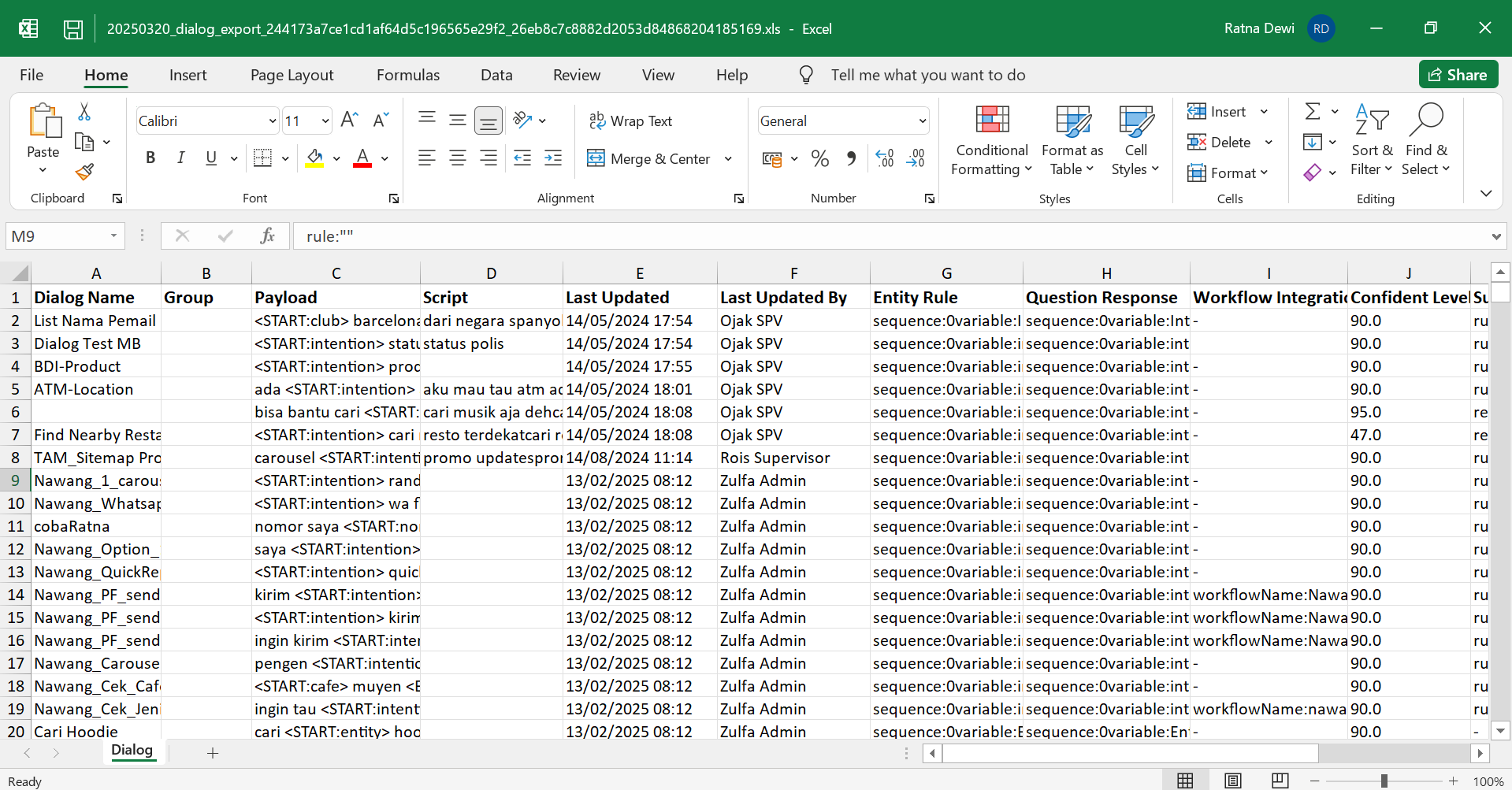
If it success, the file will be automatically saved to your local storage. The following is an explanation of the contents file are as follows.

<figure><img src="https://765826444-files.gitbook.io/~/files/v0/b/gitbook-x-prod.appspot.com/o/spaces%2FLYDAnLjpg2T8z2BplJOS%2Fuploads%2FdELyCmsJazxu65DhGvRd%2Fimage.png?alt=media&#x26;token=fab81994-8d84-4841-ad7c-274125f177c2" alt=""><figcaption><p>File Dialog Flows</p></figcaption></figure>

**Component Explanation:**&#x20;

<table><thead><tr><th width="313">Name</th><th>Description</th></tr></thead><tbody><tr><td>Dialog Name</td><td>The name of the dialog you use in the Chatbot.</td></tr><tr><td>Group</td><td>A place to group dialogs based on categories.</td></tr><tr><td>Payload</td><td>Contains text or a unique code to process the next response. For example, text that triggers a specific context, such as a conversation flow.</td></tr><tr><td>Script</td><td>Indicates that intentions and entities configured within the dialog. </td></tr><tr><td>Last Updated</td><td>The last time the dialog was updated, in the format DD/MM/YYYY HH:MM.</td></tr><tr><td>Last Update By </td><td>The name of the user or admin who last updated the dialog.</td></tr><tr><td>Entity Rule </td><td>Configure and validate entities according to predefined rules by applying MVEL-based rules (Java syntax).</td></tr><tr><td>Question Response</td><td>The response provided by the bot for questions asked by customers.</td></tr><tr><td>Workflow Integration</td><td>Indicates whether the dialog is integrated with a specific dialog.</td></tr><tr><td>Confident Level Dialog</td><td>The confidence score of the bot in responding to customer's message. </td></tr><tr><td>Success Response</td><td>The response provided by the bot when the conversation is successful.</td></tr><tr><td>Failed Response</td><td>The response provided by the bot when the conversation fails.</td></tr><tr><td>Cancel Response</td><td>The response provided by the bot when the conversation is canceled.</td></tr><tr><td>Unknown Response</td><td>The response provided by the bot when the system cannot understand the customer's question.</td></tr></tbody></table>